
Product Page
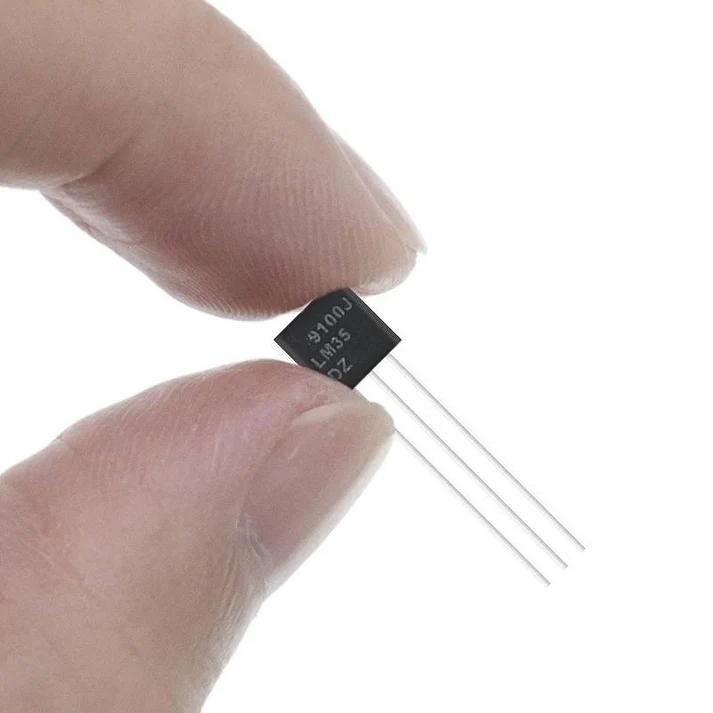
Clone LM35 Cheap Version In Pakistan | microsolution.com.pk
₨ 200
[yith_wcwl_add_to_wishlist]
Need some help?
Contact Us
Product Ships in
2-3-business Days
Payment Methods:

Clone LM35 Cheap Version In Pakistan | microsolution.com.pk
If you bought a cheap, clone, or counterfeit version of the LM35DZ (typically from budget online marketplaces), you are likely to encounter one of two major hidden realities behind the plastic TO-92 casing.
Because the genuine Texas Instruments LM35 uses relatively complex internal wafer-level trimming to match a precise 10mV/°C curve, mass-produced clones skip this process or reuse entirely different silicon inside.
Here is how to figure out what you actually received and how to handle it:
1. The "Fake LM35" Scenarios
If your cheap LM35 is providing "garbage" readings, overheating, or outputting near 5V, it usually falls into one of these categories:
- Scenario A: It is actually an LM335 (Most Common)
- The Issue: Many cheap factories relabel the LM335 as an LM35 to clear stock. The LM335 is an actual temperature sensor, but it outputs in Kelvin rather than Celsius (+10mV/K).
- The Behavior: When you hook it up to 5V, it will read an alarming ~2.98V at room temperature (equivalent to 298K or 25°C) instead of the 0.25V (250mV) a real LM35 should output.
- The Fix: Treat it as an LM335. Add a pull-up resistor to VCC from the output pin, and adjust your code to subtract 273.15 from the calculated temperature to convert Kelvin to Celsius.
- Scenario B: It is a Relabeled NPN Transistor (Scam)
- The Issue: Ultra-cheap clones are sometimes just standard 2N3904 or BC547 NPN transistors stamped with the "LM35" name.
- The Behavior: If you test it with a multimeter on diode-check mode, it behaves exactly like a transistor. In a circuit, it will either get boiling hot instantly or sit firmly at a static max voltage.
- The Fix: Unusable as a temperature sensor. There is no salvageable temperature logic inside.
2. Standard Diagnostics: Is it a Clone or Real?
To quickly find out what you have, wire the sensor to a 5V power supply and Ground, then check the middle output pin with a voltmeter:
| Measured Output Voltage | Diagnosis | What it means |
|---|---|---|
| ~0.24V to 0.28V | Genuine / Good Clone | It is outputting ~250mV, meaning it is correctly reading room temp (~25°C). |
| ~2.9V to 3.0V | LM335 Clone | It is outputting ~2980mV. It is reading room temp in Kelvin (298K). |
| ~0V or ~5V (and hot) | Dead / Fake Transistor | The pinout matches a transistor base/collector/emitter, causing a short. |
3. How to stabilize a cheap "Working Clone"
If your clone actually functions like an LM35 but the temperature readings jump around erratically (a highly common issue with budget silicon), implement these hardware fixes:
- Add a low-pass damper: Connect a 1kΩ to 2kΩ resistor between the Output pin and Ground. This helps overcome the poor sinking capability found in cheap clones.
- Filter the power: Put a 0.1µF (100nF) ceramic capacitor across the \(V_{CC}\) and Ground pins right next to the sensor body to iron out electrical noise.
- Switch your reference code: Instead of relying on the fluctuating 5V USB power rail of your microcontroller, switch your microcontroller's ADC reference to its internal 1.1V stable reference. This scales your analog measurement perfectly for the low millivolt output of the LM35.
Related products
-
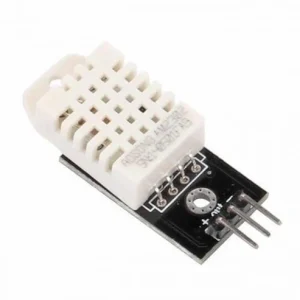
DHT22 Digital Temperature and Humidity Sensor Module | microsolution.com.pk
₨ 2,500 -
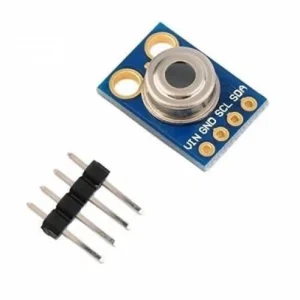
Buy infrared temperature sensor Online at Best Price in Pakistan
₨ 2,500 -
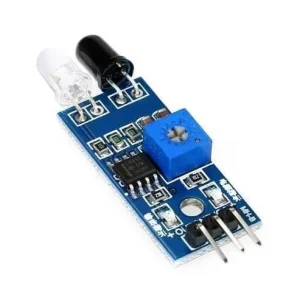
IR Infrared Obstacle Avoidance Sensor Module for Arduino | microsolution.com.pk
₨ 300 -
BMP280 Barometric Pressure Sensor Module In Pakistan
₨ 350