Product Page
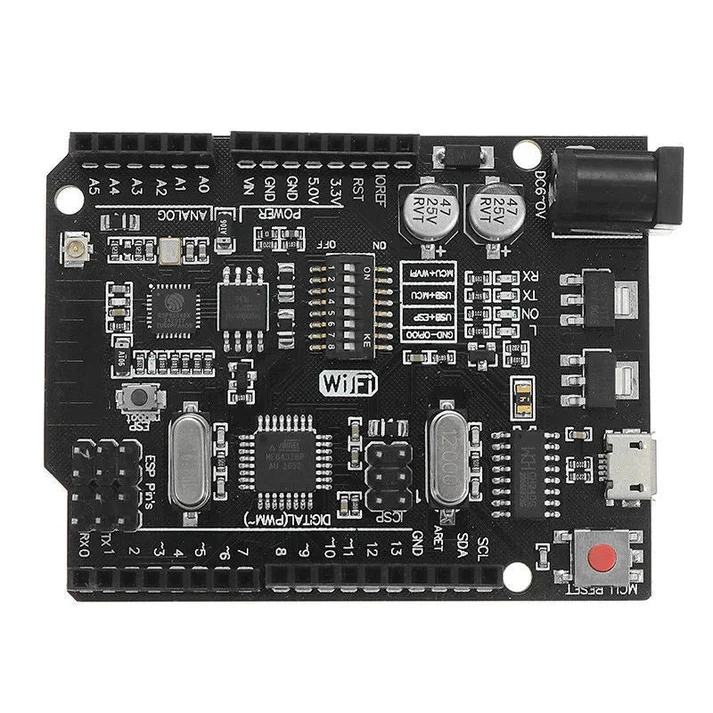
Arduino UNO WiFi R3 ATmega328P + ESP8266 8Mb USB-TTL CH340G Development Board
₨ 3,000
[yith_wcwl_add_to_wishlist]
Need some help?
Contact Us
Product Ships in
2-3-business Days
Payment Methods:

WiFi R3 ATMEGA328P + ESP8266 Development Board | Arduino UNO WiFi CH340G | microsolution.com.pk
The Arduino Uno WIFI Board with ESP8266. The Arduino Uno Wi-Fi is the same as an Arduino Uno Rev3 but with an integrated Wi-Fi module! The board is based on the ATmega328P with an ESP8266 Wi-Fi Module integrated (datasheet). It has 14 digital input/output pins (of which 6 can be used as PWM outputs), 6 analog inputs, a 16 MHz ceramic resonator, a USB connection, a power jack, an ICSP header, and a reset button. It contains everything needed to support the microcontroller; simply connect it to a computer with a USB cable or power it with an AC-to-DC adapter or battery to get started.
The ESP8266 Wi-Fi Module is a self contained SoC with integrated TCP/IP protocol stack that can give access to your Wi-Fi network. (Or the device can act as an access point.) One useful feature of Uno Wi-Fi is support for OTA (over-the-air) programming, either for transfer of Arduino sketches or Wi-Fi firmware.
Features:
- Chip CH340G – is a budget solution. When you work in the frequency 12Mhz, giving a stable result of data exchange (need install drivers to computer).
- Uno R3 CH340G/ATmega328 – connects to the computer via micro USB cable (used for almost all Android smartphones).
- You can supply power to the board through a MicroUSB connector or DC power socket.
- The voltage regulator (LDO) can deal with incoming voltage from 6V to 12V DC.
- The convenient solution for the development of new projects requiring Uno and WiFi
Specifications:
- Arduino (Atmel ATMega328P MCU)
- ESP8266 built-in module
- Arduino part
- MCU – Atmel ATmega328 8-bit AVR MCU @ 16 MHz with 32 KB flash Memory, 2KB SRAM, 1KB EEPROM
- Digital I/O pins – 14, with 6 PWM and UART
- Analog Input Pins – 6
- DC Current per I/0 – 40 mA
- Misc – Reset button
- Operating Voltage – 5 V
- ESP8266 part
- SoC – Expressif ESP8266EX Tensilica Xtensa LX106 processor @ 80 MHz
- Storage – 4MB SPI flash
- Connectivity – 802.11 b/g/n WIFI @ 2.4 GHz, wake up time < 2 ms; Antenna: PCB and IPX
- Misc – Bootloader button, WIFI LED
- Operating Voltage – 3.3 V
- Common specs
- USB – 1x USB device port
- Input Voltage – 5-12 V via DC jack, Vin or USB port (5V only)
- Power Consumption – 130 mA (sleep mode 80 mA)
- Dimensions – 68.5 x 53 mm
- Weight – 28 grams
More info & typical usage
Arduino Uno Wi-Fi board will come pre-uploaded with the Rest Server sketch that allows you to control the board via your web browser using the URL: http://192.168.240.1/arduino/<digital|analog>/<GPIO>/<ON_OFF|<INPUT_MODE>, where digital or analog let you select the IO type, GPIO the pin number, ON_OFF is either 1 or 0 for on or off, and INPUT_MODE is either input or output. Some examples:
- /Arduino/digital/13/1 – Sets GPIO 13 to high
- /Arduino/digital/13 – Reads the value on GPIO 13
- /Arduino/analog/2 – Reads Analog pin 2 value
- /Arduino/mode/13/input – Set GPIO 13 to input